


Zoeken op ZonMw
Zoeken op de website
Filters
14
resultaten gevonden voor 'Human measurement models'.
- Afbeelding
 Wij willen bijdragen aan hoge kwaliteit en grote relevantie van innovatief (bio)medisch onderzoek. Daarom stimuleren we de ontwikkeling, acceptatie en implementatie van proefdierwijs onderzoek. We streven hierbij naar betere resultaten voor de mens en uiteindelijk betere behandelingen en medicijnen.
 - Afbeelding
 Animal research often fails to predict human responses and raises ethical concerns about the morality of using animals for experiments. Six research projects focused on osteogenesis, rare diseases, schizophrenia, osteoarthritis, microbial fermentation and systemic sclerosis now receive funding to further develop their animal-free method.
 - Afbeelding
 Health research that holds good predictive value for human situations is important to ensure that outcomes can be applied to humans. Human measurement models are human-based research models, such as human cells and tissues on a chip, or on computer models based on data collected in humans. By using these models, health research is expected to be better predictable and faster applicable for…
 - Afbeelding
Health research that is of high predictive value for humans is important. Human measurement models, utilizing data, tissues, and cells from humans, center around the human perspective. They allow research to become more predictable and applicable to patients. To stimulate the development of these human measurement models, the Samenwerkende Gezondheidsfondsen (SGF), ZonMw and Health~Holland (Top…
- Afbeelding
 Following our earlier save-the-date, we are happy to invite you to register for the sixth Program Day of the Human Measurement Models (HMM) program, which will take place on the 4th of November 2026
 - The use of plastic products, including packaging material, textiles, and rubber tires, can result in the release of tiny plastic particles in the environment. These tiny plastic particles, known as micro- and nanoplastics (MNPs), are increasingly found in our environment, including drinking water and food. However, we know little about the exact exposure to these MNPs and their potential human…
- Afbeelding
 Het (bio)medische onderzoek zit in een overgangsfase (transitie) naar proefdiervrij onderzoek. ZonMw inventariseerde wat er nodig is om deze transitie te versnellen. Zo is meer onderzoek nodig om proefdiervrije innovaties te onderbouwen. In de opleiding van onderzoekers zou proefdiervrij onderzoek centraal moeten staan. ZonMw-voorzitter Arfan Ikram overhandigde vandaag de ZonMw Kennisagenda…
 - Afbeelding
 De Europese Commissie heeft op 25 juli gereageerd op het burgerinitiatief ’Save cruelty-free cosmetics – committing to a Europe without animal testing’. In de reactie van de Europese Commissie is aandacht voor de initiatieven die de transitie naar proefdiervrije innovaties zullen versnellen. De aanbevelingen zijn in lijn met het Nederlandse TPI-beleid.
 - Afbeelding
 ZonMw is making funding available with the Create2Solve programme, together with Stichting Proefdiervrij, for public-private partnerships to develop and/or implement animal-free innovations.
 - Afbeelding
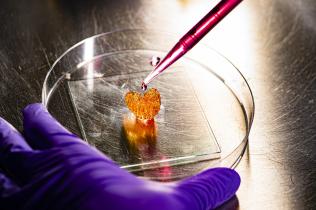 Two unique projects have been honoured in the Create2Solve Phase 2 grant round: one for the development of an in vitro model for arthritis and one for the development and standardisation of complex culture methods with animal-free reagents. The 2 consortia, which include companies, will now each receive €1 million to work on these.
 - Afbeelding
 In a joint statement, the French National Alliance for Life Sciences and Health (AVIESAN), and the Netherlands Organization for Health Research and Development (ZonMw) call on policy makers in Europe to consider essential aspects from life science research communities in the political discussions on the use of animals for scientific purposes.
 - Afbeelding
 20 talented researchers will receive an Off Road grant to explore their bold, out-of-the-box ideas within the field of (bio)medical science and healthcare. This grant offers them the opportunity to test their innovative hypotheses in 1 to 1,5 years. What do these researchers have in common? They dare to think beyond traditional boundaries.