


Sustainable Breakthrough: Two ground-breaking Create2Solve projects honoured
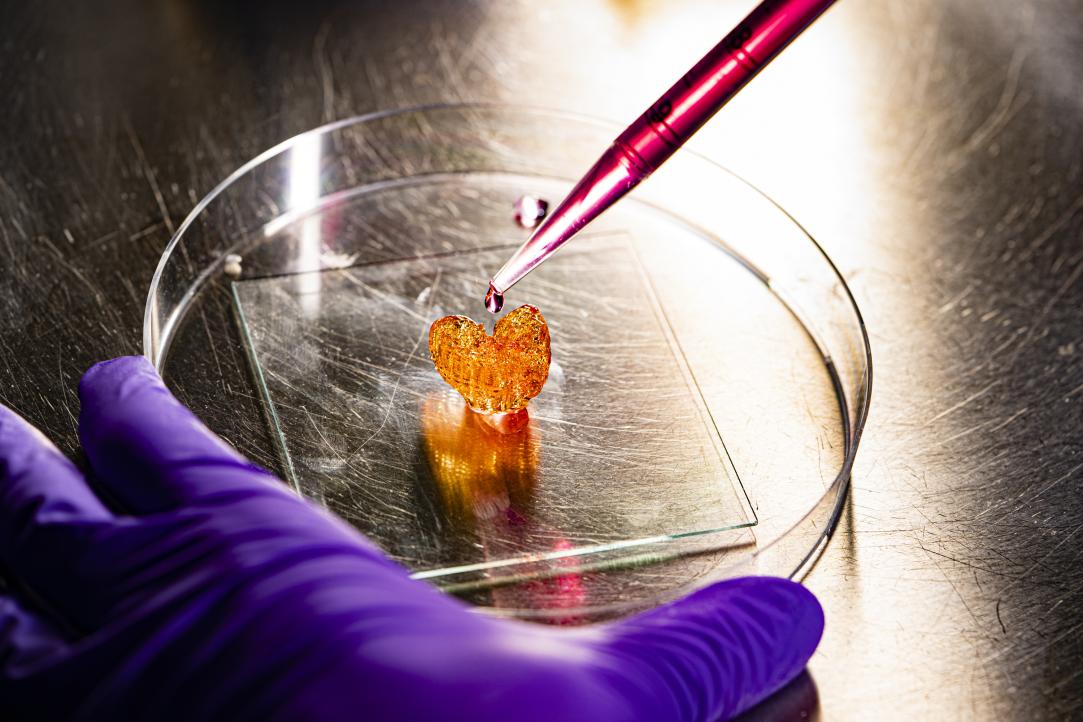
Two unique projects have been honoured in the Create2Solve Phase 2 grant round: one for the development of an in vitro model for arthritis and one for the development and standardisation of complex culture methods with animal-free reagents. The 2 consortia, which include companies, will now each receive €1 million to work on these.
Create2Solve: joining forces
With the Create2Solve instrument, ZonMw stimulates the development of innovative, animal-free methods through public-private partnerships. The involvement of commercial/industrial partners is particularly important as a starting point within Create2Solve, to encourage these promising models to become not only scientifically but also commercially valuable.
Animal-free challenges
The starting point of Create2Solve are 5 predefined scientific issues, for which a solution must be found, in order to promote human health. In the current round, these were the following specific challenges:
- Development of in vitro models for drug development against arthritis
- Development of human fit-for-purpose models for testing toxicity using metabolic parameters
- In vitro measurement of human allergy development
- In vitro development of high-affine antibodies
- Development and standardization of complex culture methods with animal-free reagents
Phased approach
In Phase 1 of this Create2Solve round, 6 proof-of-concept projects were previously honoured; in these, the consortia involved were given funding to show in 8 months that they could provide an animal-free solution to one of these challenges.
In Phase 2, the participating consortia submitted a new application to ZonMw with their findings; these were thoroughly assessed and, based on this, 2 projects are now allowed to realise their ideas: one project focuses on the development of in vitro models for drug development for various forms of arthritis (Challenge 1), while the other project focuses on the development of new culturing methods for human mini-organs with completely animal-free reagents (Challenge 5). Both projects now receive a grant of €1 million to realise the prototype development and validation in the coming years.
Stronger together
This grant call is part of the ZonMw programme "More Knowledge with Fewer Animals" (Dutch acronym MKMD), which has been programming on the development and use of alternatives to animal testing for the last 25 years.
The MKMD programme is funded by the Ministry of Agriculture, Fisheries, Food Security and Nature, but also by Proefdiervrij (The Dutch Society for the Replacement of Animal Testing), which has also made funds available for this Create2Solve round.
In this way, we can jointly work towards a future in which research and innovation rely less on animal testing and the results are more predictable for humans. To this end, Create2Solve's public-private collaborations are key to pooling the expertise of the academic and commercial worlds to accelerate the transition to sustainable, animal-free methods.
-
ARTEMIS: Advanced Research on Tissue Engineering Models for Inflammatory joint diseases
Prof. Sander Tas, Amsterdam UMC
In this project we will develop animal-free alternatives for drug development for various forms of arthritis. These diseases cannot be cured and often result in joint damage. Although treatment has improved tremendously, many patients do not respond adequately to current treatments. Consequently, a great unmet need for new medicines exists. Currently, animal models of arthritis are used to develop new medicines, but these models are not reliable predictors of clinical responses in humans. Moreover, these experiments cause serious animal discomfort. Therefore, a team of researchers from Amsterdam UMC, Twente University, Glasgow University, AstraZeneca and Chiron will develop models that mimic the inflamed joint tissue and the interaction with cartilage and bone as closely as possible. These human model systems should provide an alternative means to test the efficacy of investigational drugs for the treatment of arthritis, making the use of testing in animal models largely superfluous.Transition to Animal-free Organoids, phase 2: To the Market (TRAFO 2TM)
Dr Kouwer, Radboud University Nijmegen
Important steps in drug development can already be achieved without using animals. For example, scientists grow mini-organs in the lab. Unfortunately, these so-called organoids are grown in a material derived from mouse tumors, which requires millions of animals each year and, additionally, the variable nature of the supporting material has an undesirable impact on study results. In this project, scientists from Radboud University, HUB Organoids, and SBMatrices are developing complex culturing methods using entirely animal-free reagents (Challenge 5). The goal of the project is to introduce the first fully animal-free organoids to the market by the end of the project. Additionally, we aim to bring the necessary materials and technology to the market to make them available for academic and industrial researchers.