


Youth Healthcare

As a youth healthcare professional, how can you work according to the latest scientific insights? With knowledge development and guidelines, we contribute to the competences of professionals in youth healthcare (JGZ). So that the JGZ can even better realise its preventive role in the care of children and young people in the Netherlands.
Providing knowledge for the JGZ
Keeping knowledge up-to-date and connecting to new developments is the essence of professionalisation. For JGZ professionals, this means working according to the latest guidelines and evidence-based methods. For over ten years, ZonMw has worked with researchers and professionals to contribute to knowledge for the JGZ.
Practical knowledge for JGZ professionals
As a JGZ professional, do you want to work with the latest scientific knowledge? A paper publication with practical advice and an associated digital publication provide concrete guidelines that allow professionals to make use of the latest innovations, new approaches, methods and tools. It is divided into ten themes:

Guidelines for the JGZ
There are 35 YHC guidelines covering various area’s such as sight, growth, AHDH, psychological problems, breastfeeding, weight, child abuse etc. YHC guidelines are fundamental to support knowledge and decision making of Youth healthcare professionals but also facilitate the education of parents and youth and shared decision-making.
Our objective is to improve the quality of health care for parents and children by working with the latest knowledge and reducing variation in practice and outcome. This is done through the development and dissemination of national clinical guidelines containing recommendations for effective practice based on current evidence. All YHC guidelines can be consulted on the NCJ website.
From guidelines to guideline modules
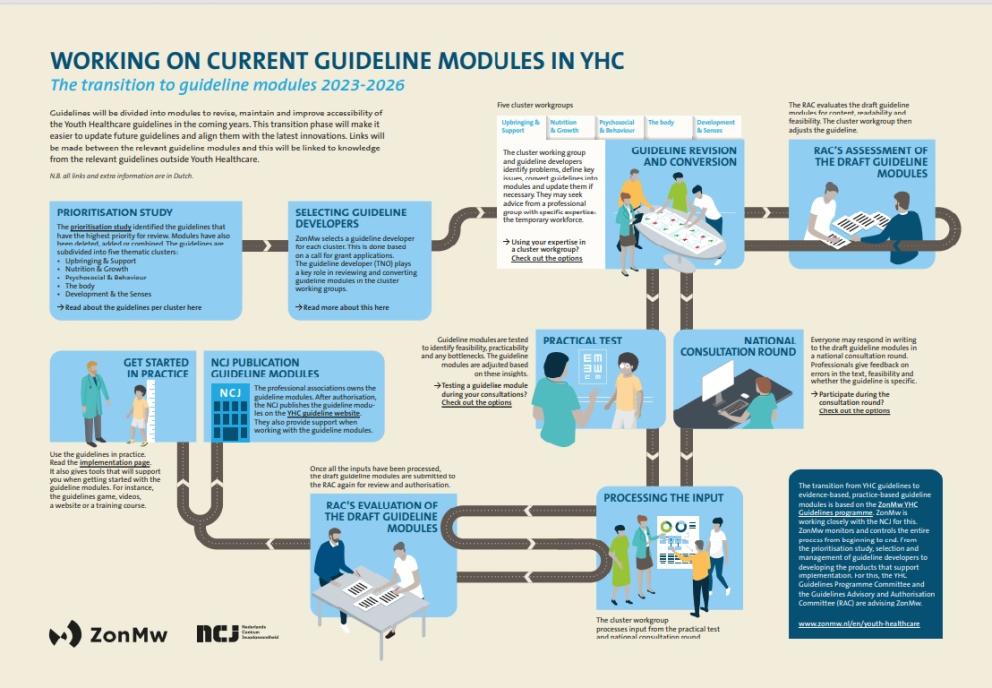
The guidelines are currently being converted to modulesover the coming years to facilitate the revision, maintenance and improved accessibility of the guidelines. This will make it easier to update sections without having to revise the entire guideline. This approach will also make it possible to connect to other guideline modules more efficiently and improve the implementation of the guidelines in practice.
ZonMw is working closely with the NCJ and TNO. Together they are building an infrastructure in which multilayered framed guidelines are regularly updated, so they are based on the latest (actual) knowledge, best practices and innovations so they can support health care professionals in their (shared) decision making.
Through the programme JGZ Guidelines 2019 – 2024, ZonMw is responsible for updating the guidelines and ensuring these remain topical. The guidelines are subdivided into five thematic clusters:
- Upbringing & Support (revision 2023-2025)
- Nutrition & Growth (revision 2024-2026)
- Psychosocial & Behaviour (revision 2024-2026)
- The body (revision 2024-2026)
- Development & the Senses (revision 2024-2026
The process of guideline development
Each thematic cluster has it’s own cluster panel consisting of a methodologist, preventive child health care professionals, (allied) health care professionals with specific thematic knowledge and the perspective of parents and youth. The guidelines are restructured into multilayered frames, assessed on latest evidence, refining the subject area and revised on the basis of systematic reviews. The guidelines are placed into a digital infrastructure where each module is elaborated on in the same structure containing recommendations, evidence assessment, evidence-to-decision tables and contributions. Guideline modules can be linked to another module clarifying the cohesion between subjects.
Check out the infographic which describes the transitional fase for guideline development. Contributing can be done in many ways, depending on available time, knowledge, skills and expertise. Check our factsheet to discover how you would like to participate in guideline development.