


Post-COVID: research programme, knowledge infrastructure and expertise network
Post-COVID, also known as Long COVID, refers to the persistent health issues that some people experience after recovering from SARS-CoV-2 infection, the virus that causes the COVID-19 disease.
About the programme
There is still a lot of uncertainty about the cause of post-COVID and its clinical presentation. In addition, there is a need for effective treatments that can reduce and/or eliminate the causes and symptoms of post-COVID. Through other programmes, such as the COVID-19 programme, ZonMw has already funded a number of studies on post-COVID, but there is a need for more structural funding and coordination of research.
The Ministry of Health, Welfare and Sports (VWS) has asked ZonMw to develop a programme for funding research into post-COVID and for establishing a research and expertise network.
Objective and strategy
The aim of the programme is to increase and share knowledge and expertise on post-COVID for diagnosis, treatment and optimising care.
To achieve this aim, the programme focuses on 4 strategies:
- Strengthening research infrastructure to support and improve the implementation of complex and wide-ranging research on post-COVID.
- Obtaining urgently needed knowledge about the causes, diagnosis and treatment of post-COVID. In doing so, links are made with research on Myalgic Encephalomyelitis/Chronic Fatigue Syndrome (ME/CFS) and other (post-infectious) conditions that cause persistent symptoms.
- (Further) development and adaptation of the organisation of care for post-COVID patients.
- Making developed knowledge and expertise accessible and usable.
Programme components
The programme is structured around 2 components:
- Research infrastructure and collaboration
- Research programme
Research infrastructure and collaboration
In this programme component a research and expertise network has been established. This network will develop a research infrastructure that makes it possible to carry out complex research into post-COVID. Research infrastructure may include initiatives that make it easier to include patients in studies, share data and samples with other researchers, or standardise research protocols and methods. In addition, the network is important for building expertise and is responsible for ensuring that available knowledge reaches healthcare professionals and patients as quickly as possible.
Research programme
This programme component focuses on developing necessary knowledge about disease mechanisms involved in post-COVID, as well as (further) development of diagnostics, treatment and care optimisation for post-COVID patients. The research programme is structured around 6 themes that will be addressed in various funding rounds:
- Preclinical biomedical research (fundamental and translational research)
- Epidemiological research and diagnostics
- (Innovative) treatments
- Care evaluation
- Follow-up research and rapid translation of research results into practice
- Urgent policy-relevant and current questions
The knowledge questions from the overarching post-COVID knowledge agenda (in Dutch) provide further direction for the research to be funded within the themes described.
Projects
To provide a clear and accessible overview of the programme, an interactive infographic has been developed that shows the interconnections between all ongoing studies within the programme, with the patient as the central point of reference. The role of the research and expertise network is highlighted as well.
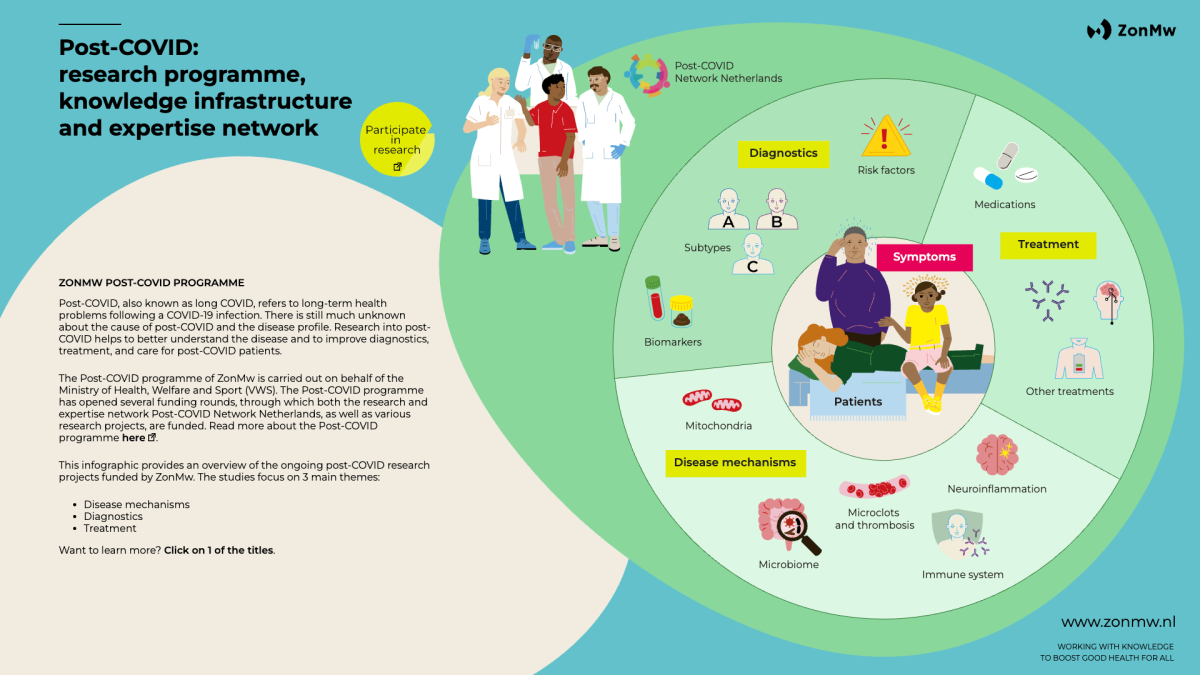
View the interactive infographic about the Post-COVID programme (ENG)
Collaboration
A well-functioning Post-COVID programme requires the involvement of all relevant parties. For optimal results, coordination and collaboration with stakeholders from policy, research and practice will be continued. The programme will also, among other things, seek alignment with other ZonMw programmes to ensure effective knowledge transfer along the knowledge chain. People with post-COVID are central to the programme. The goal is to help them as quickly and effectively as possible and to improve their quality of life. For this reason, organisations representing post-COVID patients are involved from the beginning of the programme and will also be involved in its implementation.
Programme committee
-
The Post-COVID programme committee consists of a broadly composed overarching committee, from which a subcommittee is formed for each funding round of the programme Post-COVID: research programme, knowledge infrastructure and expertise network. The overarching committee is supplemented with members over the course of the programme, based on the content of the funding rounds. For each funding round, a consideration is made as to who will serve on the subcommittee.
The Chair of the overarching committee: Em. prof. dr W.J.M. (Willy) Spaan
The Vice-Chair of the overarching committee: Em. prof. dr M. (Marianne) de Visser -
Chair
- Em. prof. dr. W.J.M. (Willy) Spaan
Committee members
- H. (Hanna) Breet
- A. (Arnold) van Halteren
- Dr. D. (Dominique) Hamerlijnck
- Em. prof. dr. E.C. (Eduard) Klasen
- Dr. J. (Jolanda) Kuijvenhoven
- L. (Lars) Luijkx
- Prof. dr. W. (Wim) Timens
- Prof. dr. J. Y. (Jan) Verbakel
- Em. prof. dr. M. (Marianne) de Visser
- Prof. dr. E. (Elisabeth) de Waele
-
Chair
- Em. prof. dr. E.C. (Eduard) Klasen
Committee members
- J.P.N. (Hans) Bet
- H. (Hanna) Breet
- Dr. J. (Jolanda) Kuijvenhoven
- Prof. dr. W. (Wim) Timens
- Dr. K. (Krista) Tromp
- Prof. dr. E. (Elisabeth) de Waele
-
Chair
- Em. prof. dr. M. (Marianne) de Visser
- Dr. J.A.M.M. (Sjaak) de Gouw (plaatsvervangend)
Committee members
- A. (Amber) Bongaerts
- H. (Hanna) Breet
- Prof. Dr. P.S. (Pieter) Hiemstra
- Dr. M. (Marlies) van Houten
- Dr. S.A. (Simone) Joosten
- Dr. T.M. (Martijn) Kuijper
- Dr. P.W.A. (Peter) Kunst
- R. (Ruud) Licht
- Em. Prof. Dr. J.W.M. (Jos) van der Meer
- Prof. Dr. W. (Wim) Timens
- Prof. Dr. G. (Gestur) Vidarsson
- Dr. J. (Johan) van Weyenbergh
- Dr. A.M.J. (Anne) Wensing
-
Chair
- Em. prof. dr. M. (Marianne) de Visser
Committee members
- A. (Amber) Bongaerts
- J.P.N. (Hans) Bet
- Prof. dr. P.J.E. (Patrick) Bindels
- Dr. M. (Michel) Briejer
- Em. prof. dr. J.M.A. (Joop) van Gerven
- Prof. dr. I.C. (Inge) Gyssens
- Dr. M.E.W. (Martin) Hemels
- Prof. dr. P.G.M. (Peter) van der Heijden
- Dr. J. (Jolanda) Kuijvenhoven
- Dr. C.C. (Coretta) van Leer-Buter
- C. (Carlien) Roelofzen
- Dr. T. (Tom) Schepens
-
Chair
- Em. prof. dr. M. (Marianne) de Visser
Committee members
- J.P.N. (Hans) Bet
- H. (Hanna) Breet
- Dr. M. (Mireille) Dekker
- Prof. dr. E.J.M. (Edith) Feskens
- Dr. C. (Chahinda) Ghossein-Doha
- Dr. A. (Bram) Goorhuis
- Em. prof. dr. J.M.A. (Joop) van Gerven
- Prof. dr. P.G.M. (Peter) van der Heijden
- N. (Nienke) Ipenburg - van Zelst
- J. (Jojanneke) Kant
- Em. Prof. dr. J.W.M. (Jos) van der Meer
- Em. Prof. dr. M.W.G. (Ria) Nijhuis-van der Sanden
- C.A. (Carlien) Roelofzen
- Dr. C.L. (Clementien) Vermont
- M.M. (Monique) Wilmer
-
Chair
- Em. prof. dr. M. (Marianne) de Visser
Committee members
- A. (Amber) Bongaerts
- J.P.N. (Hans) Bet
- H. (Hanna) Breet
- Dr. C. (Chahinda) Ghossein-Doha
- Em. pProf. dr. J.M.A. (Joop) van Gerven
- Prof. dr. F. (Frank) van Lenthe
- Dr. T. (Tessa) van Loenen
- Prof. dr. S.P. (Simon) Mooijaart
- Dr. J.J. (Jan) Oosterheert
- Dr. H. (Hadewijch) Vandenheede
- Dr. A. (Aly) Waninge
- N. (Nienke) Ipenburg - van Zelst
-
Chair
- Em. prof. dr. M. (Marianne) de Visser
Committee members
- J.P.N. (Hans) Bet
- Dr. B (Bianca) Blom
- Em. prof. dr. J.M.A. (Joop) van Gerven
- Prof. dr. R. (Rieke) van der Graaf
- Prof. dr. D.E. (Rick) Grobbee
- Dr. M. (Marlies) van Houten
- Prof. dr. V.W.V. (Vincent) Jaddoe
- J. (Jojanneke) Kant
- Prof. dr. J. (John) Penders
- M.M. (Monique) Wilmer


