How are things with | The Stroke Triage App
In the event of an ischemic stroke, every second counts. This project focuses on improving care and recovery in patients suffering from an ischemic stroke through innovative technology and more efficient decision-making in the ambulance. Faster treatment and better patient outcomes. Christian talked to project leader Prof. Bob Roozenbeek.
Christian | What is your research about?
Prof. Roozenbeek | "The project is about patients with an ischemic stroke . People who have an acute blockage of one of the arteries of the brain. And as a result, suddenly develop neurological symptoms such as a crooked mouth or a paralyzed arm or leg or difficulty speaking. If a patient has this, you have to go to the hospital as soon as possible to get the right treatment.
We actually have two important treatments at hand. The first treatment is with a drug via an IV. Intravenous thrombolysis, the drug dissolves the blood clot that clogs the artery. Or if the blood clot is larger and cannot be properly dissolved by this medicine, the other option is through the groin, where the specialist advances a tube to the blocked artery in the head and removes it mechanically. We call this a thrombectomy. And in our project, we want to be able to estimate, in the ambulance, which patient may have to undergo that thrombectomy.
Why is that so important; we know from both thrombolysis and thrombectomy that they work better when they are applied quickly. And before our project, patients were taken to the nearest hospital. There they looked at what was going on and possibly gave the blood clot-dissolving medication. But if the patient was also eligible for treatment through the groin, but that treatment was not applied in that hospital, the patient had to be transported back in the ambulance to a specialist hospital. This leads to delays and therefore less chance of a good recovery.
What we are trying to do with our project is to make an estimate in that ambulance which patient can best be taken to the nearest hospital, to prevent the thrombolysis treatment from being delayed. And which patient is better off driving past that nearest hospital because the chance that a thrombectomy treatment has to be applied through the groin is so great that you prefer to drive a little further immediately, in order to have that treatment performed faster and thus be more effective."

Christian | And what do you ultimately want to achieve with the research? And especially with the use of the app.
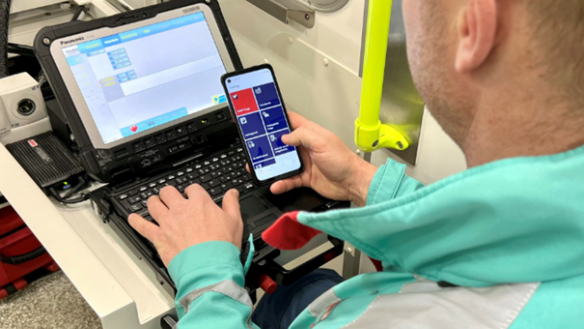
Prof. Roozenbeek | "We developed an algorithm within this project, and we then converted it into an app called the stroke triage app. Which can be used by ambulance nurses.
The app uses different parameters. First of all, the severity of the loss of function. So the paramedic does a physical examination and looks at how serious the symptoms are. Because we know that if the symptoms are more serious, the chance that someone has to undergo groin treatment is greater.
But it also takes into account the time since the onset of the complaints, and the driving times to and between the different hospitals, by means of a GPS connection.
And the app takes all these different factors into account to estimate the chance of recovery after 3 months if the patient goes to the nearest hospital, or to the intervention center further away. The one that is most likely to have a good recovery, that strategy, the app advises the ambulance nurse."

Christian | Yes, because what phase is this project in at the moment?
Prof. Roozenbeek | "We have been using the app for a year now. We started the implementation a year ago. We intend to continue measuring this year in order to analyse the results by the end of 2025 and to be able to make a statement as to whether the app does indeed lead to faster treatment.
What we also expect is that, because patients recover better, less long-term care is needed or, for example, rehabilitation treatment or nursing in a nursing home. That ultimately that app will also lead to healthcare becoming cheaper. So that not only leads to better outcomes but also to lower healthcare costs. And we hope to prove that by the end of 2025."