


Accelerating Global Transition Towards Animal-Free Research and Innovation
What is needed to further accelerate the international adoption of animal-free testing methods? This question was the focus of the successful and inspiring stakeholder meeting held on 13 May by the three consortia AFARA, SAFE and Valuing Testing.
New Approach Methodologies (NAMs)
Representatives from academia, industry, policy, and regulatory bodies gathered at the Ministry of LVVN to reflect, exchange knowledge, and explore opportunities for joint action.
The meeting was opened by Erica van Oort, program coordinator of TPI, followed by two inspiring keynote lectures. Laura Holden addressed the socio-technical barriers surrounding the adoption of New Approach Methodologies (NAMs), while Mirjam Luijten highlighted both the challenges and opportunities of next-generation risk assessment.
In the afternoon, participants took part in parallel world café sessions. Across three 30-minute rounds, they engaged in discussions on key themes such as complexity, uncertainty, and trust in chemical safety testing; barriers and facilitators for animal-free methods; and the functioning of regulatory pathways for the acceptance of innovative testing strategies.
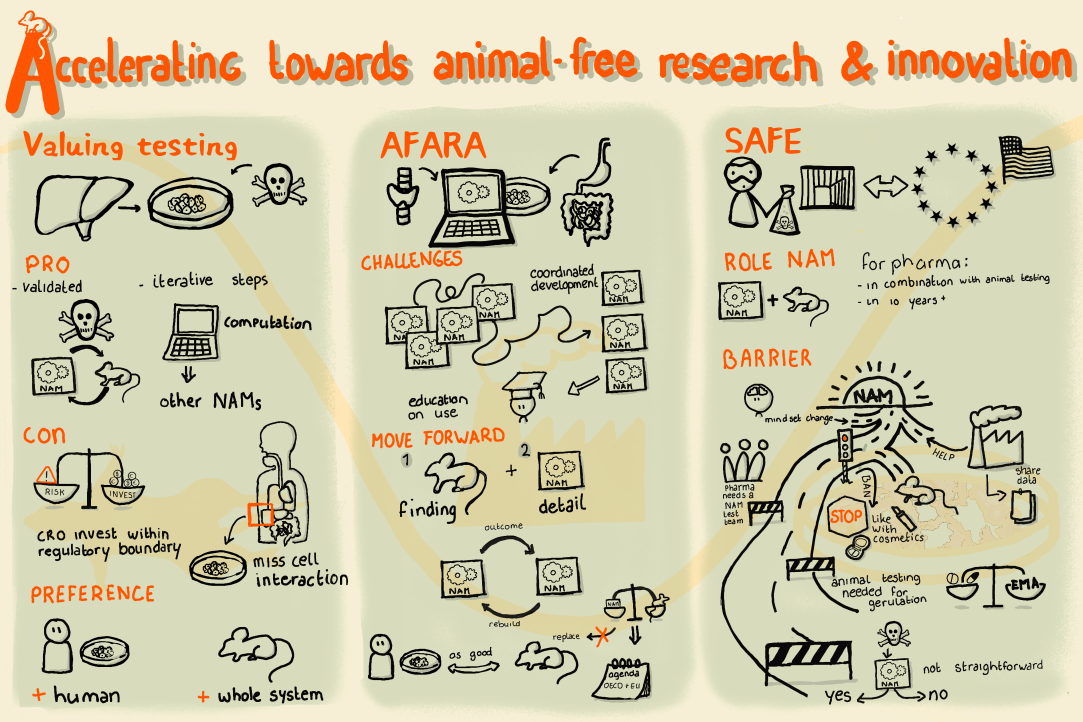
The sessions were facilitated by the three 'NWA Animal-Free Assessment Models' consortia, see below, who used the participatory approach to capture insights and perspectives directly from the audience. Key insights were documented in a live visual report created by illustrator Angela Lansbergen-Engel, which was presented during the plenary wrap-up.
Drie consortia
AFARA
The AFARA consortium focuses on implementing NAMs to identify endocrine-disrupting chemicals, a field that presents both unique opportunities and challenges. The stakeholders mentioned a lack of focused coordination in the development of models as a major barrier, and considered what levels of change would be required to fully utilise NAMs within risk assessment in the EU.
SAFE
What does the future of NAMs in 10years look like and what barriers are there to use more NAMs in the future? The participants of the SAFE session highlighted the need for a mindset change and current the legal-regulatory system as major obstacles. The EMA procedure for qualification and industry sharing data are promising avenues for accelerating the transition and avoiding a feedback loop where animal testing remains the gold standard.
Valuing Testing
The Valuing Testing consortium investigated where and why participants place greater or lesser value on study outcomes. The focus was on what is required to trust the results and the role played by the complexity of the model system – for example, a cell model versus an intact animal. They also discussed how to deal with conflicting results between non-animal methods and animal experiments when assessing chemical safety.
Looking ahead
The meeting provided valuable insights and conveyed a sense of optimism: the transition towards animal-free innovation is clearly gaining momentum, and an increasing number of stakeholders recognise the importance of NAMs. At the same time, participants emphasised that clear communication about both the capabilities and limitations of NAMs is essential to build trust and understanding within society. This realistic approach was seen as crucial for enabling further progress.
Click here for more information about the consortia AFARA, SAFE en Valuing Testing