


Consortium gets to work on integrated policy on Planetary Health

Government policy affects the health of people and the planet. Over the next 5 years, a broad consortium will therefore develop an approach to help the Dutch government take this interaction into account in its policy. They are doing this with a grant from the NWA programme ‘Building blocks for integrated policy on Planetary Health’.
It is becoming increasingly clear that the health of humans, animals and the planet constantly influence each other. As a result, many initiatives have been launched to restore or improve this – disrupted – health balance. The Dutch government is also introducing a growing number of policy instruments, such as the Climate Act, the National Adaptation Strategy and the Green Deal for Sustainable Care. However, there is still a lack of a government-wide, cross-domain approach.
The NWA programme Building blocks for integrated policy on Planetary Health responds to this need. Its focus is on developing a broadly applicable approach for a Planetary Health Impact Assessment (PHIA). This builds on existing frameworks for Health Impact Assessment (HIA) and Environmental Impact Assessment (EIA).
Compass for health policy
Over the next 5 years, the CINPHIA consortium will develop, among others, a Planetary Health Compass to generate useful knowledge for feasible, integrated policies that protect and restore planetary health. Policy makers will use this compass to map out the possible effects of policy prior to decision-making, so that they can make timely adjustments. In addition, this will increase the involvement of citizens, civil society organisations and the business community in formulating clear and achievable goals.
‘CINPHIA’s mission,’ explains project lead Marleen Bekker, ‘is to facilitate a decisive joint approach to protecting our health and our living environment. By bringing together researchers, policymakers and professionals from various sectors with citizens, we want to ensure that important decisions always consider what is good for both people and the planet.’
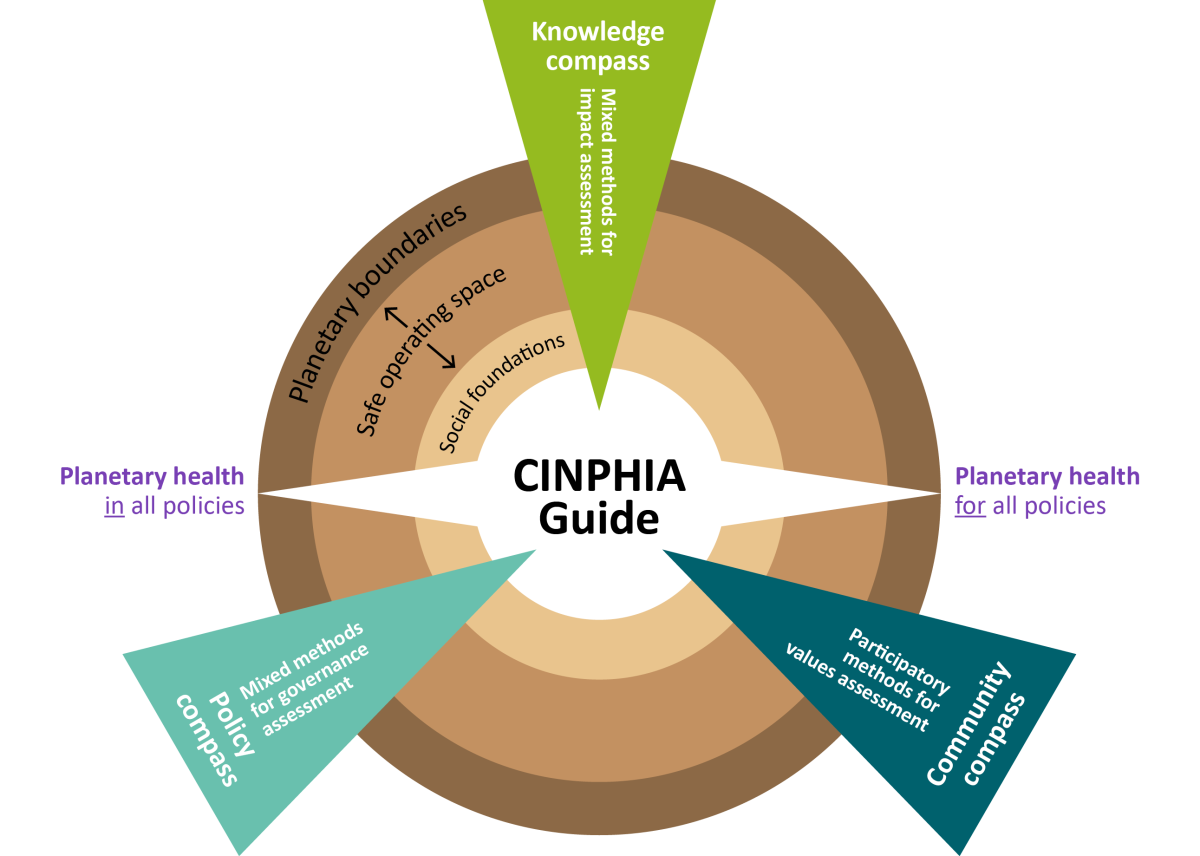
Unique collaboration
In the consortium ‘Co-creation and Integration of Planetary Health Impact Assessment in policy practice (CINPHIA)’, various parties are working together to achieve scientific and societal impact. The project lead is Dr Marleen Bekker of Wageningen University and Research. Consortium partners are ClimateHUB Rotterdam, Erasmus MC, Erasmus School of Health Policy & Management, GGD Rotterdam, InHolland, KWR, PDPC, Province of North Holland, RIVM, Rotterdams Weerwoord (municipality of Rotterdam), SEVEN - University of Amsterdam and Waag Futurelab.
Collaboration partners are Amsterdam UMC, Centre for Planetary Health Policy, Doughnut Economics Action Lab, eXtreme Citizen Science Hub, University of Applied Sciences Leiden, KNMP, Ministry of Infrastructure and Water Management, Ministry of Health, Welfare and Sport, Open Research Amsterdam, Planetary Health Alliance, Province of South Holland, Public Health Wales, Vereniging Innovatieve Geneesmiddelen and VEWIN.
Planetary Health
Planetary Health is broadly defined as a solution-oriented, transdisciplinary field and social movement that focuses on analysing and addressing the consequences of disrupted natural systems for all life on earth. The health of these natural systems is essential to human health. Want to know more about how ZonMw focusses on Planetary Health? Take a look at the page on One Health and Planetary Health.
Dutch Research Agenda (NWA)
Citizens are at the heart of creating and renewing the Dutch Research Agenda. The link between society and science is a key element of the NWA programme. Governments, researchers, civil society organisations and citizens work together to develop and use knowledge to achieve scientific and societal impact. And through science communication, knowledge is shared in society to increase engagement and trust in science.