


ZonMw Pearl Award project GRIP3


It is not easy to include patients of family doctors in medical research projects. ‘There are approximately 5,000 family doctors in the Netherlands, and they are all extremely busy,’ explains Professor Jochen Cals from the University of Maastricht.
Removing obstacles to conduct medical research with patients of family doctors
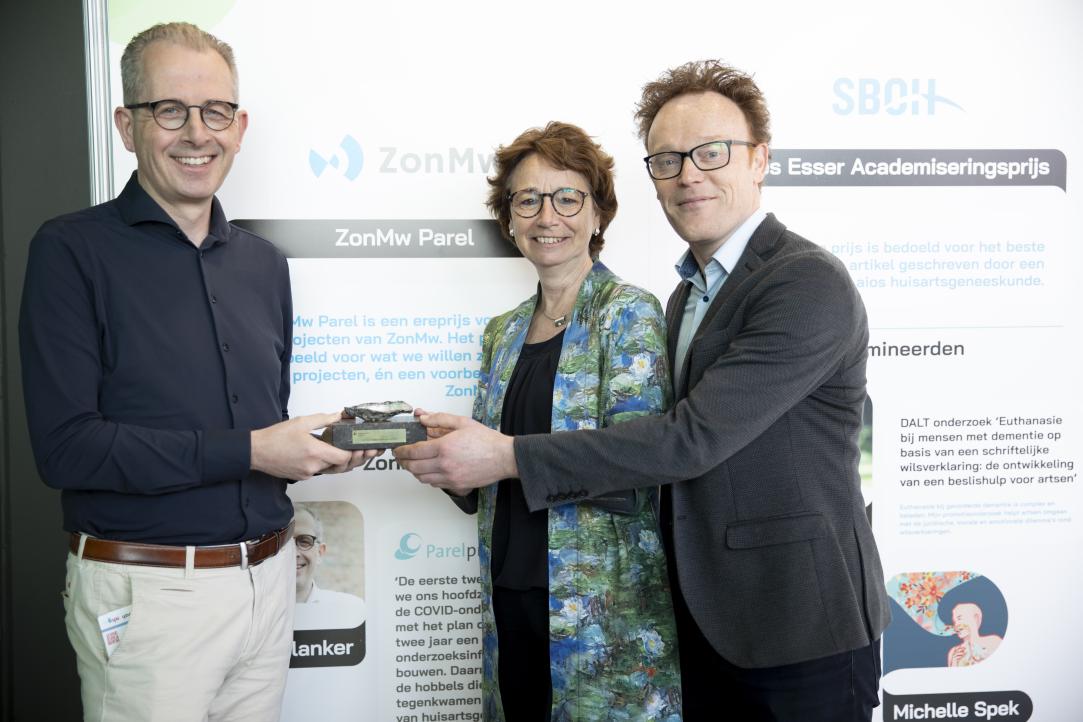
Ever since 2020, the GRIP3 research consortium has been studying various aspects of COVID-19 at practices of family doctors in the Netherlands. Over the years, the consortium has contributed to removing obstacles for research. This consortium includes researchers from every university department of family health care in the Netherlands as well as the Netherlands Institute for Health Services Research (NIVEL). At the General Practitioner Days (Huisartsendagen) in April 2025 the Pearl Award of ZonMW is presented to these researchers for their excellent work.
‘The fact that general practitioners are so fragmented makes it hard to include their patients in medical studies.’ For some time now, the 7 university departments of family medicine in the Netherlands have been aiming to improve this situation via the Family Medicine Research Consortium (Consortium Onderzoek Huisartsgeneeskunde) At the start of the COVID-19 pandemic in 2020, their added value immediately became clear. ‘Initially, patients who died due to COVID outside the hospitals were not included in the statistics. Until Marco and I began an ad hoc study to start online registration,’ says Professor Cals, referring to general practitioner Professor Marco Blanker from the Groningen University Medical Centre. ‘We did so in close collaboration with ZorgDomein, the Dutch platform that family doctors are using to refer their patients to specialists in hospitals. All the university departments of family medicine were immediately in favour of doing this. Within a few weeks, as many as 50% of all general practitioners registered deaths and palliative care at home. This was an unparalleled success.’
Creating Facilities
Later on in the year 2020, the consortium was invited by ZonMw to apply for funding from GRIP3. This is funding for research into various aspects of COVID-19 health care. Professor Cals: ‘During the first 2 years we focused mainly on COVID topics, but we planned to build a more permanent research infrastructure in the final 2 years. We wanted to permanently remove the obstacles that we so often come across when conducting research with patients of family doctors.’
‘This turned out to be rather essential’, explains Professor Blanker. ‘During the first research projects, we came across so many barriers such as a lack of infrastructure, but also time-consuming procedures at local medical-ethical assessment committees, that we could only finalise inclusion once the COVID pandemic had already nearly come to an end.’
However, it was not a waste of time and resources. Professor Blanker: ‘On the contrary, if there will ever be a new pandemic we can start doing research much more quickly. What’s more, we can also use what we have created for other kinds of research, for example into cystitis or shoulder pain.’
‘We need broad support for the importance of good infrastructure for Dutch research into family medicine. Not just from institutions that provide research grants, such as ZonMw, but also from health care funds that can benefit from this. We also need support from the university medical centres via the Federation of University Medical Centres in the Netherlands (NFU). Recognition and support from all these organisations should lead to sufficient funding for new research projects.’
AI diagnostics
There was, however, other research that did get off to a good start during the COVID pandemic. Professor Cals: ‘We soon learnt that it was possible to diagnose COVID-19 purely based on the words that the general practitioner typed.’ This AI-model can also be extended to other diagnoses. ‘We are now training it to identify vulnerable elderly people,’ says Professor Blanker. ‘Our next step is to go back to the general practitioners with this model, so they can apply it in health care. We are working on this with companies such as ExpertDoc and Health Base that offer applications for information systems for family doctors.
If I include a patient from a small village near Groningen in a study that is being coordinated from Maastricht today, research medication will be delivered to that patient tomorrow
Infrastructural modules
How exactly did GRIP3 contribute to permanently removing obstacles for conducting research with patients of family doctors? Professor Blanker illustrates this with an example: ‘If I include a patient from a small village near Groningen in a study that is being coordinated from Maastricht today, research medication will be delivered to that patient tomorrow. We have set up a network of pharmacies that can supply research medication throughout the Netherlands.’
During the final year of this research project, other infrastructural modules are still being worked on. ‘For example, a module with which family doctors can register patients for research studies via ZorgDomein,’ says Professor Cals. ‘We also want to use Thuisarts.nl to point out to patients which research studies are being conducted for certain diseases. We have already put this into practice for the recently launched post-Covid centres of expertise in the Netherlands. Patients can register themselves directly to take part in the research study.’
Trial network
The researchers are also setting up a national trial network in the Netherlands, consisting of dedicated family medicine practices for scientific research. ‘These practices for family medicine have the right infrastructure and funding to be able to include patients in new research studies,’ explains Professor Cals.
The 35 practices of family medicine, spread across 7 areas of work, are not necessarily large practices for family medicine. ‘General practitioners who work on their own can also contribute a great deal,’ says Professor Blanker. ‘It is more important whether someone is motivated to be proactively involved in scientific research, rather than the total number of patients registered with a family medicine practice.’ Professor Cals: ‘It is our intention that this trial network continues to develop and grow in the future.’
Should there be a new pandemic in the future, researchers can drop all the other research projects they are doing and focus completely on the new infectious disease. This is why it is important to continue to invest in this network, also when the attention for pandemics fades away. ‘Only then will we be ready and prepared to do what is necessary at a moment’s notice,’ according to Professor Cals.
We all benefit in the end because of the scientific output
Beer mats
The connection between the various university departments for family medicine have only become closer thanks to GRIP3. ‘Everybody realizes that we are in this together,’ says Professor Cals. A number of agreements have been made to keep it crystal clear how we work together. ‘For example, there is the no-surprise agreement,’ says Professor Blanker. ‘If you are working on a project proposal to apply for funding, you will also report this to the group. As soon as at least 3 organisations are involved in a research project, we will operate under the flag of that consortium.’
To the outside world the consortium has one voice. ‘We are one point of contact for the projects that exceed the family doctor practices such as the post-Covid network,’ explains Professor Cals. ‘This makes us clearly visible and easy to approach.’
One of the reasons why this collaboration is working so well, is because trust has been built between partners. Professor Cals: ‘We are happy to grant projects to others and there is reciprocity.’ Professor Blanker: ‘We all benefit in the end because of the scientific output.’
The researchers emphasize how much the funding by ZonMw has meant for conducting scientific research in family medicine practices. Professor Cals: ‘For many years we have come up with all kinds of solutions on the back of beer mats to remove obstacles. But thanks to GRIP3 we could really get these solutions off the ground and make our plans come true.’
Improving collaboration between research and practice
The Academic Living Lab or Family Medicine
The collaboration between the Departments of Family Medicine at university hospitals in the Netherlands will be intensified by the new ZonMw programme Academic Living Labs for Family Medicine (Academische Werkplaatsen Huisartsengeneeskunde AWH). Thanks to a major grant for the duration of 3 years, regional academic practices and the Dutch national networkwill strengthen their ties for more collaboration between practice, research, education and training in the field of family medicine.
The Academic Living Labs will be able to apply new knowledge of research projects. Family doctors will give feedback to researchers about what works well and what the specific needs are. This network, which also includes the NHG, will facilitate this knowledge exchange, encourage both regional and national collaboration and share best practices. This is how the research agenda can focus even more effectively on the knowledge that is needed. All this will be in the best interest of family medicine and excellent quality of care given by general practitioners in the Netherlands.
More information
Colophon
Text: Diana de Veld
Image: Sander van Eijk
Video: Fixvision
Final editing: ZonMw

